
#11: Germany’s fireworks madness

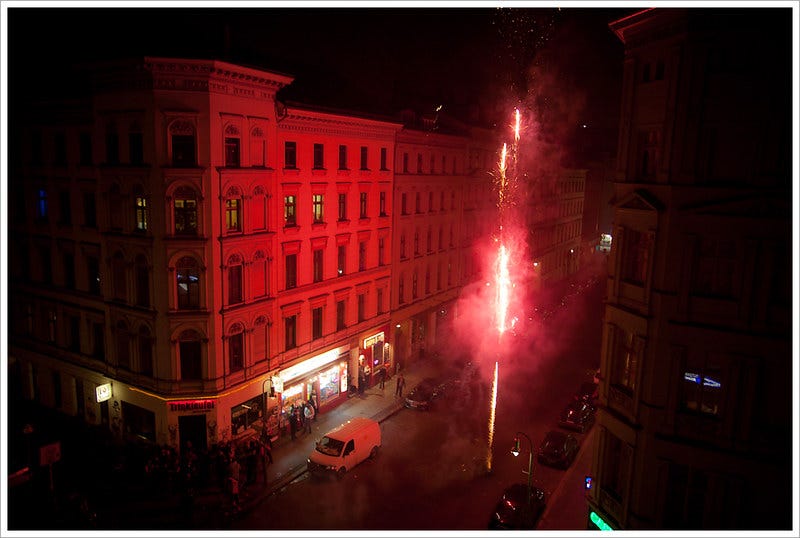
Josh Axelrod here, filling in for Maurice over the holidays, as he spends some much-deserved time with family in Denmark. There, he’ll join the Danes for their time-honored New Year’s Eve tradition: jumping off a chair as the clock strikes midnight.
Cross cut to Berlin’s end-of-year countdown for a jarring contrast: fireworks exploding every which way for days on end. I still remember my first New Year’s in Berlin, where I shimmied through a crawlspace and onto the roof of a Kreuzberg Altbau for a panoramic view of the city lit up in emeralds, crimsons, sapphires, and golds. It was downright romantic from my perch high above the city — that is, until my hungover trudge back home on street-level, where I recoiled with each hiss, pop, or shriek, afraid to find myself in the path of a missile.
☝️Last New Year’s Eve, one tourist in particular pissed off Berliners after he posted a video of himself accidentally firing a bottle rocket into a child’s bedroom, where it exploded (harming no one, fortunately).
I’m not the only Berliner with mixed feelings about Silvester fireworks. Three out of four residents say they want them banned, according to a poll last month from rbb24. And 87% of respondents say they support more firework-free zones in the city. The cause has brought together an unlikely alliance from all corners of the city: environmentalists and animal-rights activists to police and emergency workers.
A petition from Berlin Police Union (GDP) to ban fireworks Germany-wide picked up a whopping 2.35 million signatures this year, with text that reads, “What we experienced last New Year’s Eve was beyond all bounds. This massive violence against our colleagues must stop,” referring to reports in recent years of young men deliberately attacking first responders — even ambulance crews — with fireworks.
They may finally get their way after years of lobbying to change Germany’s Sprengstoffverordnung or explosives ordinance. Currently, the law says that authorities can ban Silvester fireworks “with an exclusively loud bang effect in certain densely populated communities.” The proposed change would remove that clause.
This is no sure thing. Right now, it’s just a pledge from Federal Interior Minister Alexander Dobrindt to make the proposal. Implementation wouldn’t come until Silvester 2026 at earliest, at which point local communities would have the authority to ban fireworks where they see fit. Berlin, for example, could impose a ban within the S-Bahn ring, reports Tagesspiegel.
The legislative progress is the handiwork of Böllerciao (a play on Bella ciao and Böller, a German word for fireworks) — an initiative that includes environmental NGO Deutsche Umwelfhilfe , the national medical association, the country’s biggest police union, and more than 50 other environmental, animal rights, and medical organizations.
The groups wrote an open letter to Dobrindt and have so far collected more than 800,000 signatures on their petition. They received advice from Jan Tjeerd de Faber, a Dutch eye doctor who successfully lobbied for a ban in the Netherlands, according to The Times.
“During my first shift on New Year’s Eve in 2003, I was supposed to save a young boy’s eye, which had been severely damaged by a firework … I did not succeed,” de Faber said. “Year after year, I have witnessed children and wholly innocent bystanders suffering the worst injuries from fireworks.”
They’ve got a good case for a ban with several key reasons that have mobilized support.
First and foremost is the danger to residents, police, and medical workers. Last year, five people were killed and hundreds more were injured across the country, including a police officer and a 14-year-old who blew off parts of his hand.
Then there’s the environmental toll of fireworks. The explosions release about 4,200 tons of fine particulate matter into the air, or 2% of all the fine dust emitted in Germany a year. Ever wonder why the Berlin air quality map is often red? That’s the equivalent of two months of dust emissions from road traffic, says a report commissioned by the Scottish government in 2020, using Germany as a case study.
That’s to say nothing of the microplastic pollution that ends up in our water, chemical remains that make their way into the soil, and the release of contaminants that contribute to climate change.
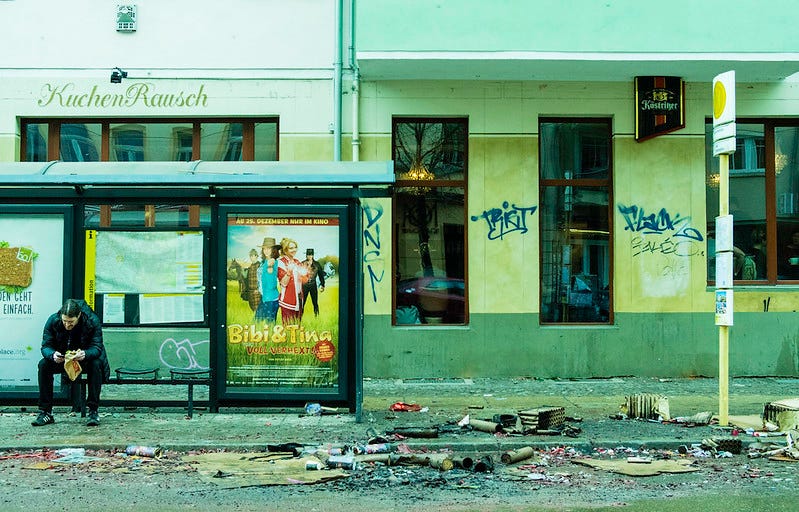
Plus there’s the effects on wildlife: Birds feel the pain of the shock waves in the sky, pigs and horses can injure themselves in a panicked flee, and pets go missing after running scared from the loud noise.
So if reasons abound, why has it taken so long to consider a major change to the Sprengstoffverordnung? Despite support from city-states like Berlin and Bremen, there’s been opposition from the Flächenländer (Germany’s larger, more rural states), creating a political logjam.
“I find a ban on fireworks somewhat odd,” then-Chancellor Olaf Scholz said last January, just weeks before the country’s national election. He told firefighters: “We must have clear rules on what pyrotechnics can be used and take tough action against all those who do not comply with the law. That’s the right way to go.”
On the political spectrum, the least likely to support a ban are voters of the business-friendly FDP and the far-right AfD, citing reasons like cultural tradition and opposition to government overreach. Former FDP leader Christian Lindner said that “anyone who overdoes it at the turn of the year becomes an accomplice to the killjoys who want to ban everything by law.”
And in an answer that sounds an awful lot like the discourse around gun violence in America, AfD politician René Kühn said, “The fireworks are not the problem, so a fireworks ban cannot be the solution. The problem is the people who misuse the fireworks to injure other people and damage property.”
Also, predictably, in the don’t-ban camp: fireworks manufacturers. It’s big business for Weco, Comet, and Nico, the big three pyrotechnics providers in Germany, bringing in €197 million at the turn of 2025, up 10% from the year before. They do 90-95% of their business in the several days leading up to Silvester.
They’ve lobbied hard against the types of outright or partial bans passed in the Netherlands (as of this summer), Ireland, Chile, and Australia. Manufacturers already had their worst nightmare realized with a ban in 2020 and 2021 during the pandemic. During that period, eye injuries and pyrotechnic profits plummeted in tandem.
Fireworks are currently banned in specific areas. There’s a nationwide ban on lighting up fireworks near churches, hospitals, fire-sensitive buildings, retirement homes, and foster care facilities. Most cities have also set up prohibition zones — in Berlin that includes Alexanderplatz and the Brandenburg Gate; in Düsseldorf, the entire old town is off limits.
But come 2026, when more extensive bans could go into effect, what will Silvester in Germany look like? The possibilities are endless.
In Spain, celebrants shove 12 grapes in their mouths at midnight. In Greece, they hang onions on the front door to symbolize rebirth. And in Japan, they ring bells 108 times, each representing one of Buddhism’s sins.
But Colombia has to take the cake for their array of zany New Year’s traditions: people walk around the block with an empty suitcase, stuff their pockets with lentils, wear a pair of yellow underwear, and place three potatoes under the bed — one peeled, one unpeeled, and one half-peeled — before choosing one to predict your future wealth. (Hint: You don’t want the peeled one.)
There’s still plenty of time to mull over some new traditions here in Germany. In the meantime, once Maurice picks himself up off his midnight-toppled chair, he’ll be back for the first newsletter of the new year. Guten Rutsch! and please stay safe this holiday season!
Thanks for reading!
Josh
What else happened this week?
Deutsche Bahn’s plan to improve punctuality
AfD gathering intel for Russia?
Indian students facing deportation
Russia deems Deutsche Welle an undesirable organisation
💰 Money-Saving Tip of the Week from Smart Living in Germany
If you’ve been thinking about getting supplemental dental insurance, December is the best time to do it. Many plans start with a lower reimbursement limit and increase it every year, often based on the calendar year. When you sign up in December, that first year is over almost immediately — and your coverage limit already increases again in January.
One provider that lets you take advantage of this is Münchener Verein, which is also one of the better-rated dental insurers in Germany. They offer plans covering 75%, 85%, or 100% of eligible dental costs with no waiting period. Pricing depends on your age and the plan you choose (for example, the 75% plan costs €18.90/month if you’re 40). If you sign up online for the 85% or 100% plan before the end of December, you also get a €15 Amazon voucher. You can get a quote and sign up here* (affiliate link).
Looking for more tips on saving money and navigating life in Germany? Subscribe to the Smart Living in Germany newsletter.
Our other newsletters:
Friends:
 | A guest post by
|
This issue highlights the ineptitude of German politicians and their misguided attempts to seek one-size-fits-all solutions that don’t need to be.
If Berlin wants to ban fireworks, why should Brandenburg be forced to? They shouldn’t be.
If people want to enjoy fireworks, let them be done by trained professionals at places like Brandenburg Gate and Tempelhofer Feld while having a ban for everyone else. How is that hard to do?
Germans are all a little crazy, TBH. They forbid and scold jaywalking, citing safety as the reason, but they will allow people to freely use explosives in densely populated areas. Make that make sense.
This whole topic is a no-brainer and yet it takes decades for them to ever do anything about it.
The first Substack post I ever published (Jan ‘23) focused on Berlin fireworks. Still drives me BANANAS.
https://daniellazar.substack.com/p/from-order-to-chaos?r=17kb8y